

- This event has passed.
Total solar eclipse in 2026
12 August | 8:30 pm – 8:31 pm
Teruel is already preparing for the first total solar eclipse visible from the Iberian Peninsula in more than a century.
This will take place at sunset on Wednesday , August 12, 2026, at 20:30, with a duration of 1 minute 34 seconds, the first total solar eclipse visible from the Iberian Peninsula in more than a century.
This will require observing the eclipse from a location with good visibility to the west. Since it will be in summer, the chances of clear skies are high in a large part of the country. We will provide more information throughout the coming year.
The totality band of this eclipse will cross Spain from west to east and will pass through many provincial capitals such as Teruel. Spain is located at the end of the totality band, so it will happen when the Sun is setting very close to the horizon. This will make it necessary to observe the eclipse from a place with good visibility to the west. As it happens in summer, the chances of having a clear sky are high in a large part of the country.
(https://astronomia.ign.es/web/guest/eclipses-de-sol-y-luna/eclipse-total-sol-de-12-de-agosto-2026).
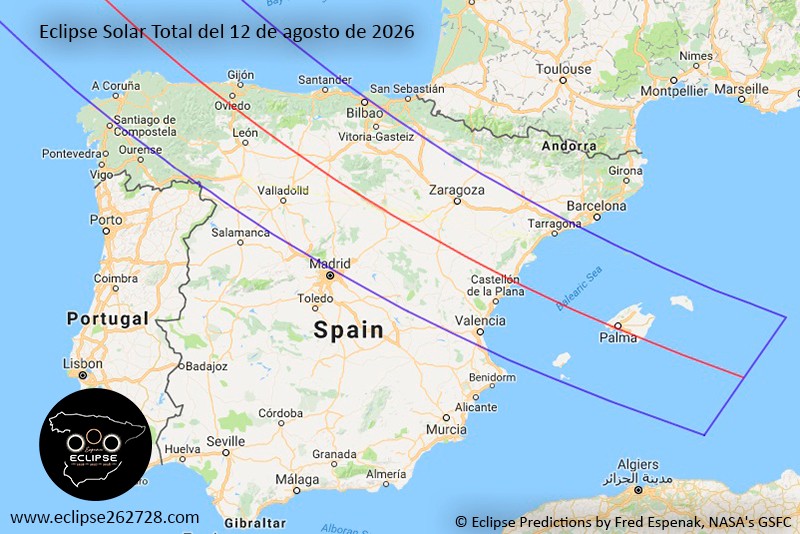
Source: eclipse262728
*Somewhere in this section, a countdown of the days remaining until the eclipse.
(Various resources at this link https://theskylive.com/solar-eclipse?id=2026-08-12&geoid=3121238&lang=es#google_vignette)
Therefore, the Maestrazgo region is an ideal destination to observe these phenomena, since its location is privileged, being in high mountains, with viewpoints where we find neither vegetation nor infrastructure and a very low light pollution.
Recommendations to make this experience unique:
- Reserve in advance your lodging and food site.
- Bring cash. Not all accommodations offer card payment.
- Plan your trip. Leave your home early and measure the times and breaks you are going to take along the way.
- DO NOT look directly at the sun without protection. Buy specialized eclipse viewing glasses that meet the international standard ISO 12312-2. Ordinary sunglasses will not work.
- If your telescope has solar filters suitable for the eclipse, it will not be necessary to use specialized eclipse glasses, but remember, you will NOT be able to look at the sun directly, only through your telescope.
- Find the area from where you want to see the eclipse and leave your car well parked.
- Don’t leave waste lying around. Take garbage bags with you and throw them away when you see a dumpster.
- Keep in mind that to access the viewpoints you will have to walk a certain distance. Take your time to walk it quietly and appreciate the scenery.
- We recommend that you carry a headlamp, a flashlight or some other object that will help you light up on the way back.
Precautions:
- The Sun should never be observed directly or with sunglasses. During a partial eclipse, the Sun is never completely covered by the Moon and therefore looking at it without any safe and adequate protection can damage the eyes.
- The Sun should not be observed with devices (cameras, videos) or instruments (telescopes, binoculars) that are not prepared for it and have the corresponding solar filters. Nor should it be observed with filters that are not approved for safe observation of the Sun.
- The Sun can be safely observed by viewing its image projected on some kind of screen in the shade. For example, the image obtained on a wall or a ceiling with a flat mirror covered internally with a paper to which a hole of less than 1 cm in diameter has been cut out. Do not look at the image of the Sun in the mirror, look only at the projected image.
- The Sun can be safely observed by means of filters commonly called eclipse glasses. They must be approved by the European Community for solar observation and must be used following the instructions printed on them. They must be in perfect condition. Do not walk while wearing them, preferably remain seated. Do not remove them until you have taken your eyes off the sun. They should not be used with optical devices, although they can be superimposed on a pair of prescription glasses.
- The use of optical instruments is not recommended except by professionals or experts with recognized experience in solar observation. Do not use solar filters that screw onto the eyepiece, as they reach a high temperature and may break. If necessary, filters should be placed in front of the objective.